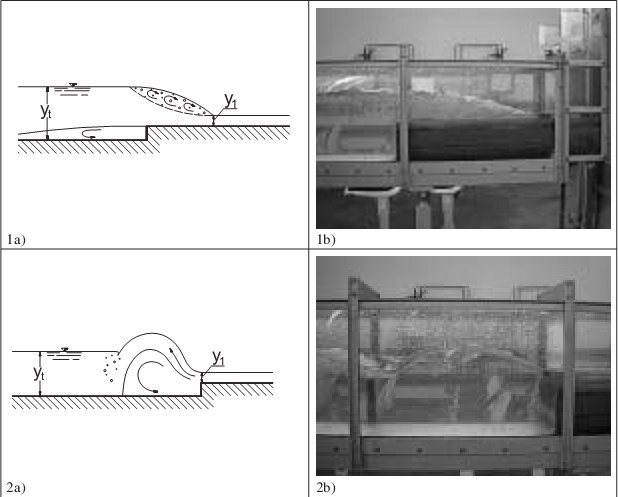
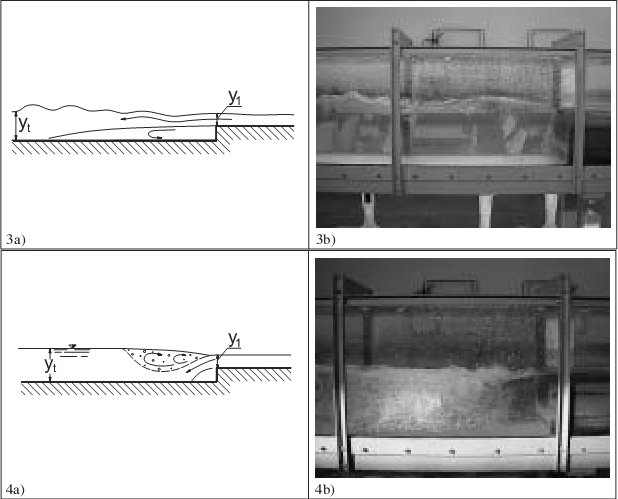
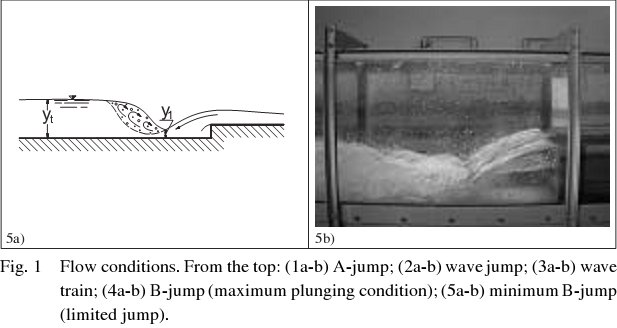
Utformning av damm för att få surfvåg/vals
Nedanstående bilder och text hämtade från Chris Joosses artikel The Model- SoleduckThe Peshastin dam
The Peshastin dam serves a very important purpose- it diverts water to serve local agriculture, one of the area's primary industries.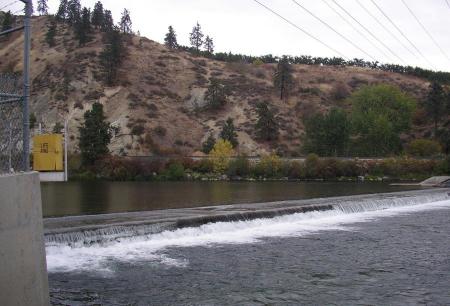
The primary concern posed by this dam is that due to its shape, it forms a
100-foot-wide pourover hydraulic that poses an extreme hazard to anyone
or anything caught in it- this is easily the most dangerous feature on
this river, which is already heavily used as a recreational resource.
The dam is heavily signed, (hazard!) The dam is operated by the Wenatchee Reclamation District.
The hazard is this: during snowmelt, (the time when the river is most-used) the hydraulic created by the dam is a drowning machine. It is an accident waiting to happen. What many people don't understand is that this is totally unnecessary- there is no need to accept a hazard as the cost of having a diversion dam in the river.
Currently the hydraulic caused by the dam creates a serious hazard in the middle of one of the more heavily-used recreational rivers in the state. A person or vessel caught in this hydraulic will potentially recirculate for hours unless rescued. (It should be mentioned that life expectancy under such circumstances can predictably be measurable in minutes.) It's not uncommon to watch logs and other flotsam stay there for hours, being driven under, floating back to the surface, then being fed back into the hydraulic by its powerful backflow.
The existing dam is adequately marked as a hazard, and this may be the reason why no fatalities have occurred there. This sort of marking provides some safety, but does not mitigate the lost recreational opportunities potentially available.
The dam is heavily signed, (hazard!) The dam is operated by the Wenatchee Reclamation District.
The hazard is this: during snowmelt, (the time when the river is most-used) the hydraulic created by the dam is a drowning machine. It is an accident waiting to happen. What many people don't understand is that this is totally unnecessary- there is no need to accept a hazard as the cost of having a diversion dam in the river.
Currently the hydraulic caused by the dam creates a serious hazard in the middle of one of the more heavily-used recreational rivers in the state. A person or vessel caught in this hydraulic will potentially recirculate for hours unless rescued. (It should be mentioned that life expectancy under such circumstances can predictably be measurable in minutes.) It's not uncommon to watch logs and other flotsam stay there for hours, being driven under, floating back to the surface, then being fed back into the hydraulic by its powerful backflow.
The existing dam is adequately marked as a hazard, and this may be the reason why no fatalities have occurred there. This sort of marking provides some safety, but does not mitigate the lost recreational opportunities potentially available.
The Diversion Dam on the Soleduck river
The opportunity the current situation presents can be seen in the example demonstrated by another diversion dam: The fish hatchery diversion dam on the Soleduck River is known far and wide for the fact that during flood conditions, the wave it creates is nearly ideal for recreational purposes.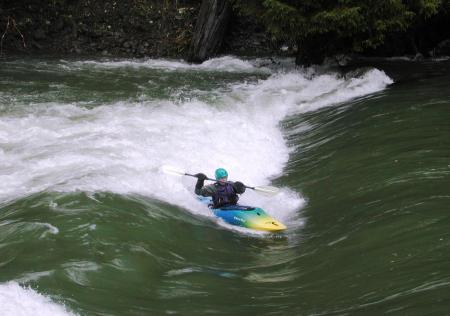
The picture seen here
demonstrates what is possible with a dam at medium (roughly 3,500cfs)
flow. The major difference between this hydraulic and the one
created by the Peshastin dam is that objects that enter this hydraulic
flush out immediately.
The difference between these two dams is in the shape of the downstream face: whereas the Peshastin dam is a straight dropoff, the Soleduck dam has an uneven, ramping downstream face, which allows downriver traffic (in the case of the Soleduck, drift boats) to safely pass at regular flows.
The proposal is to modify the Peshastin dam to resemble the one on the Soleduck. This modification would not degrade the very important functions the dam already serves- it would greatly enhance the recreational value of this part of the river.
The Wenatchee River between Leavenworth and Cashmere is a summertime recreational resource of considerable value- every year there's a Wenatchee River Festival, featuring competitions that draw competitors and spectators from around the world. This is one of the most heavily-used rivers in the state when it comes to recreation.
The dam at Peshastin has every potential of being the high point of the river, instead of being the low point. It is already a man-made interference, and there's no question that it provides value- what we propose is to add more value to the equation by converting a major hazard into a major recreational asset.
The Diversion Dam on the Soleduck river is a model dam, something we'd like to see anywhere there's a man-made structure in the river. Its chartered purpose is to divert water through the fish hatchery, even at low flows.
Later it was modified from its original design to facilitate the passage of river users- the ramp in the middle allows drift boats to pass, even at low flows as seen in the picture to the left.
The difference between these two dams is in the shape of the downstream face: whereas the Peshastin dam is a straight dropoff, the Soleduck dam has an uneven, ramping downstream face, which allows downriver traffic (in the case of the Soleduck, drift boats) to safely pass at regular flows.
The proposal is to modify the Peshastin dam to resemble the one on the Soleduck. This modification would not degrade the very important functions the dam already serves- it would greatly enhance the recreational value of this part of the river.
The Wenatchee River between Leavenworth and Cashmere is a summertime recreational resource of considerable value- every year there's a Wenatchee River Festival, featuring competitions that draw competitors and spectators from around the world. This is one of the most heavily-used rivers in the state when it comes to recreation.
The dam at Peshastin has every potential of being the high point of the river, instead of being the low point. It is already a man-made interference, and there's no question that it provides value- what we propose is to add more value to the equation by converting a major hazard into a major recreational asset.
The Diversion Dam on the Soleduck river is a model dam, something we'd like to see anywhere there's a man-made structure in the river. Its chartered purpose is to divert water through the fish hatchery, even at low flows.
Later it was modified from its original design to facilitate the passage of river users- the ramp in the middle allows drift boats to pass, even at low flows as seen in the picture to the left.
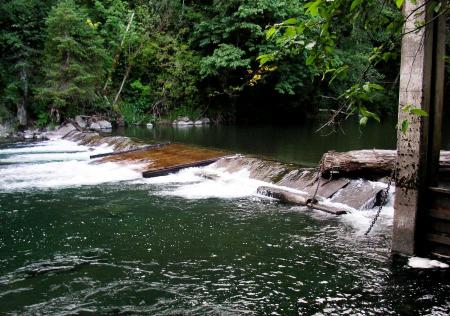
Whether intentionally or not, this design resolves the principle safety issues we normally encounter with traditional lowhead dams, at all flows, even those beyond the range of where you'd see Drift boaters on the river. Indeed, at higher flows, this diversion dam forms a water feature that is highly desirable in terms of recreation- the wave works at a wide range of flows and provides safe/easy passage for small craft such as kayaks at any flow.
- At higher flows, the dam begins to form a wave that's very friendly in terms of recreation- it is a nearly ideal wave for recreational purposes- stable, smooth, great for surfing, and if you flip, you'll flush out immediately.
- At medium-high flows, the shoulders of the dam begin to form as a partial-depth hydraulic, while the center ramp forms a longer, faster, flatter wave that remains green (that is, without breaking) in the middle.
- At High flows, the gap in the middle closes, causing a breaking wave across the entire river that is less retentive than the shoulders are at medium-high flows.
- At Very high flows, the shoulders wash out and the wave becomes enormous in the middle.